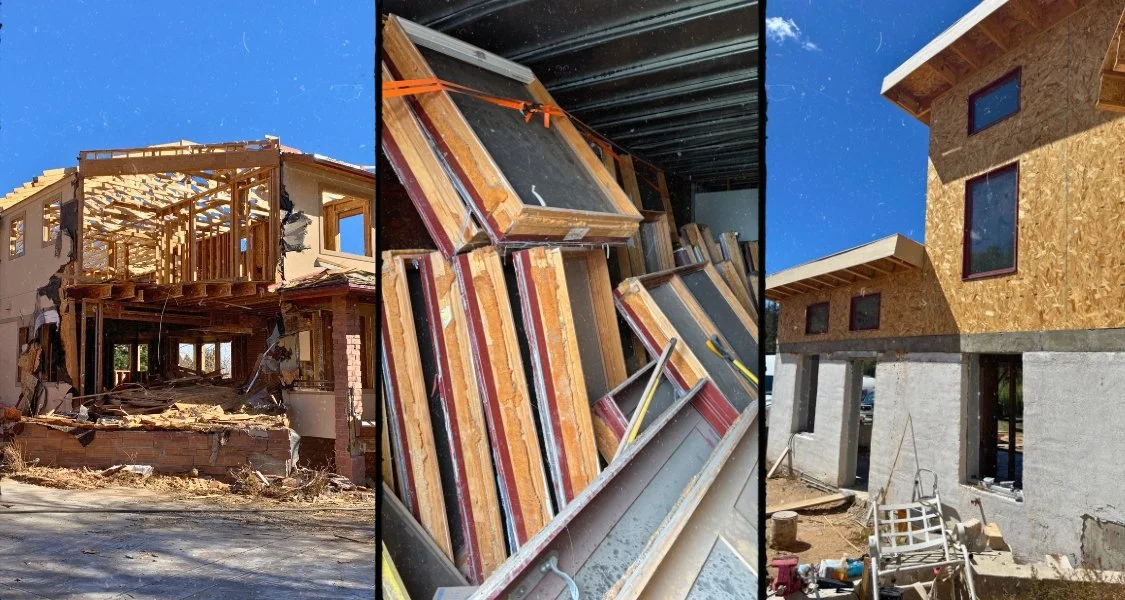
Reclaimed and reused in three steps: A Boulder home being carefully deconstructed, salvaged windows staged in storage, and those same units installed in a new earth brick home in Jefferson
When we talk about building reuse into the plan, this is what it can look like in real life.
In 2021, Perks Deconstruction completed a full house deconstruction on a large, relatively new home in north Boulder. Instead of scraping the site and hauling everything away, our crew carefully salvaged what we could: high-quality windows, doors, concrete roof tiles, trim, and more. Those materials moved through our warehouse, Perks Reclaimed, to be cleaned up, documented, and made available for future projects.
A few years later, some of those same windows are now installed in a new earth brick home in Jefferson, Colorado, an unincorporated community in South Park, designed and built by Colorado Earth for a father-son owner-builder team. It’s a clear example of how reclaimed materials can be folded into a project from the very beginning — with some planning, patience, and collaboration. Colorado Earth founder Lisa Morey went out of her way to buy the windows up front and store them until the right clients came along, showing the kind of patience and commitment that makes projects like this possible.
Step 1: Salvage First on a Full House Deconstruction
The original house in north Boulder was less than ten years old and full of materials that still had plenty of useful life ahead. On a conventional demolition, those windows, doors, and tiles would likely have been treated as debris.
Because this was a salvage-first deconstruction, our crew:
Removed the Windsor Pinnacle Series (2003) windows carefully, rather than smashing them out
Took measurements so they could be matched to future designs
Set aside other reusable materials that might fit upcoming projects
For us, this is standard practice. For builders and homeowners, it’s the difference between “demo” as pure waste and deconstruction as the first step in a reuse plan.
Step 2: A Builder Who Designs Around Reuse
Enter Colorado Earth founder Lisa Morey, whose work centers on earth block construction — an ancient earthen building technique that uses compressed earth blocks made from local soil. Dense earthen walls help keep homes comfortable year-round while reducing the need for higher-carbon materials like conventional concrete and framing.
Lisa saw an opportunity when these windows came through Perks Reclaimed and made a long-term decision: she purchased the windows (and other materials) and invested in a storage container to hold them until the right project came along.
Lisa’s approach solved a common timing challenge with reuse. There’s often a long gap between when materials are salvaged, when drawings are completed, and when it’s finally time to build, which makes it hard for architects to confidently spec reclaimed products. By purchasing the windows at the time of deconstruction and storing them herself, Lisa locked in the exact sizes and quantities she’d have to work with. When the Jefferson home was ready to move forward, she could design around a known inventory instead of hoping the same pieces would still be available.
Instead of saying, “We’ll design the house and then order windows,” she flipped the order:
Acquire a batch of salvaged windows
Store and document them
Look for clients who are open to incorporating reclaimed materials from day one
Eventually, she met a father and son owner-builder team planning a new earth brick home in Jefferson, Colorado. They were willing and excited to design their home around reclaimed windows.
That decision did a few important things at once:
Kept high-value materials out of the landfill
Made use of existing products instead of buying everything new
Gave the project a story and character tied to another Colorado home
Step 3: Designing with What You’ve Got
Using reclaimed materials doesn’t mean winging it. On this project, the team had to solve real-world details that come with reuse.
Our initial measurements ended up being off, so Lisa came back out and measured each window herself. Having her own, accurate set of dimensions was critical — it gave her the data she needed to confidently design a new home for the windows.
Confirming specs for code and energy requirements
To make sure the windows would meet building code and energy expectations, Lisa and her team needed to:
Identify the specific window series
Get the information required for energy and code compliance
Having a single source for the windows — one house, one deconstruction job — helped make that process more straightforward.
Designing openings to fit salvaged sizes
With new construction, the default approach is often:
Draw the openings → order custom windows to match.
Here, it worked in reverse:
Start with the salvaged window sizes → design the openings around them.
Step 4: Storage, Transport, and Mountain Logistics
There were also logistics to manage.
The windows and other materials were kept in a storage container until the project was ready.
The owner-builder team transported the windows from storage up to Jefferson themselves.
There was understandable concern about transporting the windows from the Denver area to Fairplay and the elevation gain, and how the glass would respond.
In the end, everything held up. The windows arrived in good shape and are now installed in the earth brick home, framing new views in a different part of Colorado.
What This Means for Your Next Project
If you’re a homeowner planning a remodel or tear-down:
Let your design team know early that you’re open to reclaimed materials.
If your existing home is being deconstructed, ask what can be salvaged and reused — either in your project or someone else’s.
If you’re a builder, architect, or designer:
Consider choosing one or two material categories to target for reuse — windows, doors, or cabinets are a good start.
Connect with partners like Perks Deconstruction and Perks Reclaimed who can help with salvage, documentation, and sourcing.
And if you’re just curious what’s possible:
This home in Jefferson is one real-world example of how reclaimed materials can move from one house to another, with a builder who’s willing to design with what already exists.
At Perks Deconstruction, this is the kind of story we aim to make possible every day: Careful deconstruction on one end, thoughtful rebuilding on the other, and materials that get to do their job for much longer than a single construction cycle.
If you’re planning a project in the Boulder or Denver area and want to learn more about deconstruction or how reclaimed materials could fit into your plans, we’re here to help.